 DISCOVER DEV.PRO’S EXCLUSIVE CTO DINNERS.




As the National Restaurant Association reports, “Nearly 75% of all restaurant traffic now happens off-premises—meaning that almost 3 out of 4 restaurant orders are taken to go.” Hospitality brands in tune with the to-go trend can cut operational costs and boost revenue.
Due to a confluence of factors in recent years, the restaurant industry has been turned on its head and reinvented. Whether it be the impact of the COVID-19 pandemic or novel innovations like artificial intelligence (AI), it’s clear that the restaurant industry will never be the same.
Today’s restaurant customers expect unfettered convenience, lightning-fast service, and hyper-personalized experiences. In turn, success requires an off-premise-first architecture where digital ordering isn’t just a bolt-on, it’s the core engine.
COVID-19: How a Global Crisis Accelerated Digital Dining
As the COVID-19 pandemic swept the globe, individuals and businesses suddenly adapted to a world where physical contact was dangerous. In turn, an industry built on in-person interactions had to pivot to survive. While these shifts were motivated by safety, the technological innovations implemented for social distancing permanently transformed restaurants.
Interesting stats that arose with the pandemic include:
- Within the first six months of COVID-19, approximately 100,000 restaurants closed (about 1 in 6 U.S. restaurants).
- Certain restaurants implemented digital ordering systems in as little as 1 week.
- Digital orders for carry-out increased by 115% from 2020 to 2023.
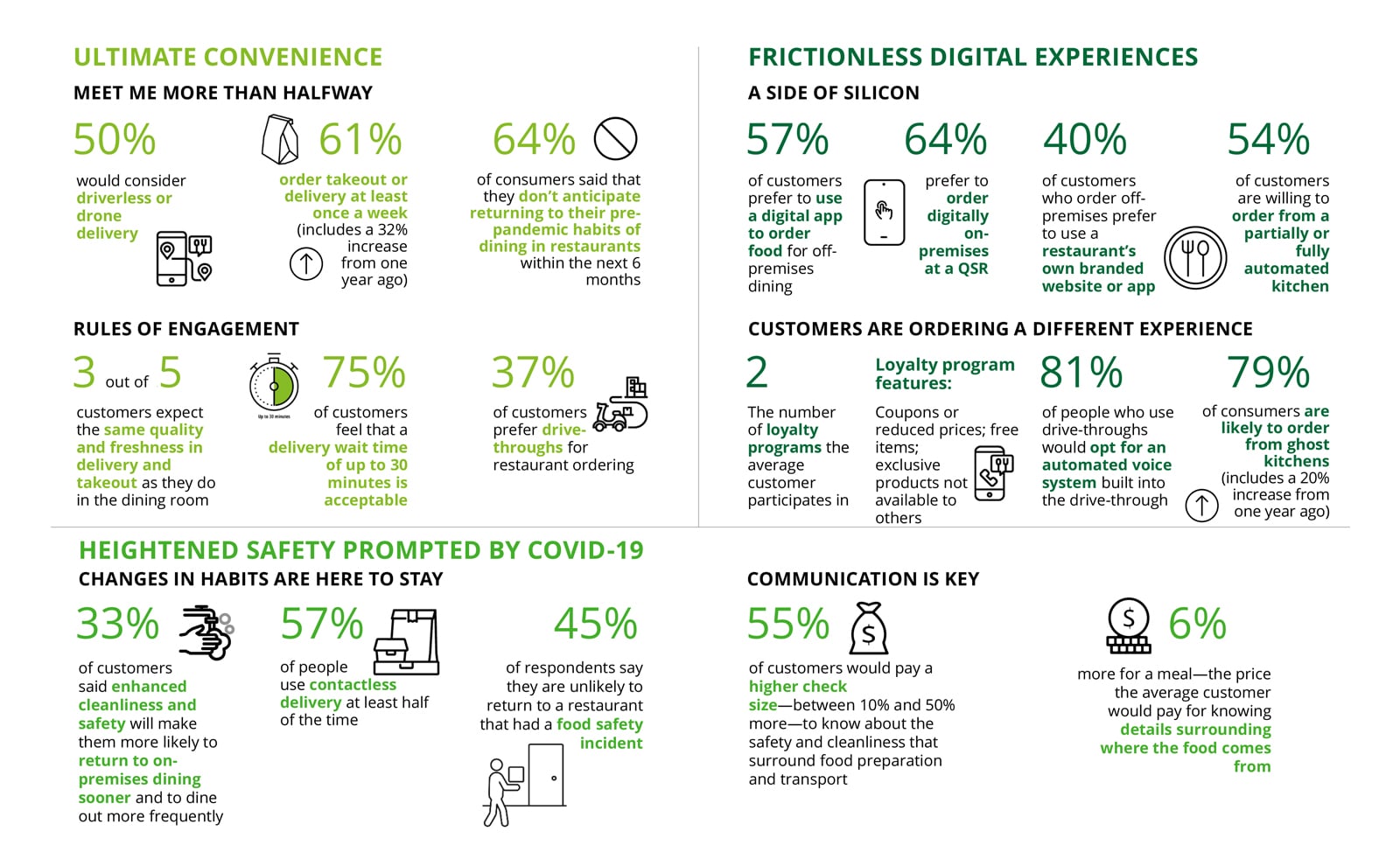
- From 2019 to 2020, the number of people who ordered takeout rose from 32% to 61%.
What began as a crisis for the hospitality industry ultimately evolved into an opportunity. In fact, many establishments now generate greater profits than before the pandemic. Forbes reports that the restaurant industry grew from $767 billion in total sales in 2019 to a record-high $981 billion in total output by 2023.
The Modern Restaurant Customer
In the post-pandemic world, technologies like custom POS, contactless payments, and QR-code menus are the norm. In turn, studies report, “94% of all consumers say speed is critical, with over 9 in 10 citing customer service as a top priority” when ordering food.
While older generations like Baby Boomers slowly adopt digital, younger generations simply expect frictionless experiences. Of millennials and Gen Z, “Two-thirds say takeout is essential to their lifestyle, and nearly 6 in 10 use takeout or drive-thru at least weekly.” Ultimately, these needs can’t be realized without key technologies like API integrations, cloud-based data syncing, and automated kitchen display systems (KDS).
The Core Benefits of Off-Premise Infrastructure
By addressing an array of important use cases, off-premise architecture and digital ordering streamline restaurant workflows and increase profitability.
Unified Operations: A Single Source of Truth
By leveraging API-first integration, restaurants eliminate the manual labor and subsequent errors that come with re-entering orders from third parties. Consolidating all digital traffic into the POS via a single avenue is both efficient and accurate. It ensures that financial reporting, inventory tracking, and labor allocation are based on 100% accurate, real-time data across channels.
Precision Fulfillment: Optimizing Freshness
When conducting delivery operations, GPS-triggered sequencing helps the kitchen synchronize production with a food courier’s actual GPS coordinates. With such dynamic accuracy behind your delivery services, courier wait times are reduced, and food quality is maintained to the highest standards.
Real-Time Menu Agility: Protecting Your Brand
Automated menu synchronization ensures that your digital storefront is always a reflection of your physical pantry. For example, when a menu item is out of stock, your entire system is automatically updated. Not only does this automation protect customer loyalty with consistent service, but it also keeps your staff from manually managing multiple dashboards.
Frictionless by Design: The Role of AI in Modern Delivery
Rapid developments in AI have ushered in a new paradigm for the off-premise era. Today, advancements like hyperpersonalization and predictive up-selling are used to solve some of the most pressing use cases for digital restaurant services.
Hyper-Personalization: The Loyalty Engine
While off-premise restaurant dynamics remove much of the human interaction in food service, that doesn’t make good service any less important. Whether it be a website, kiosk, or third-party app, these digital channels must be as attentive as waiters. By leveraging AI to analyze individual ordering patterns, restaurants offer highly personalized digital storefronts. According to Deloitte, “brands that excel at personalization” are 71% more likely to improve customer loyalty.
Predictive Upselling: Boosting Your Bottom Line
AI models analyze historical data to predict what a specific user actually wants. If a customer frequently orders gluten-free options on weeknights, the interface will make automatic suggestions like relevant substitutions and high-margin sides. This approach drives significantly higher conversion rates and average order values than the static, one-size-fits-all menus. In fact, digital food ordering with automated upselling often results in 20% higher check prices.
Voice & Conversational AI
Another new development in AI involves doing away with screens altogether. Advanced conversational AI now handles complex phone orders and in-app voice requests with human-like nuance. By integrating directly with a POS, these systems eliminate manual entry errors, suggest high-margin upsells based on order history, and free up staff to focus entirely on customer service.
Challenge: Balancing Websites vs Aggregators
To stay competitive in this evolving landscape, restaurants must strategically balance their own branded websites and apps with third-party aggregators like DoorDash, Grubhub, and Uber Eats.
While third-party aggregators offer instant visibility and pre-built architecture, they come with high commissions and obscure useful customer data insights. In contrast, first-party proprietary platforms give brands total data ownership and superior margins, while also allowing them to better capitalize on new technologies like AI.
The most successful off-premise restaurant operators utilize hybrid solutions. They leverage aggregators as an acquisition funnel for new diners, then strategically migrate them to first-party channels to secure long-term loyalty.
Summary
What began as the existential challenge of COVID-19 ultimately catalyzed a new era of efficiency and profitability for restaurants. With so much food being consumed off-premise, restaurants are finding creative ways to ensure that to-go food and service match in-house quality.
Through API integrations, GPS-triggered sequencing, and automated menu synchronization, restaurants are now delivering the frictionless, hyper-personalized services that today’s consumers demand. Ultimately, AI has become the connective tissue of the modern kitchen, allowing digital platforms to mirror the nuance and hospitality of traditional human interaction.
Is Your Tech Stack Ready for the Off-Premise Revolution?
Dev.Pro specializes in guiding hospitality brands through critical digital transformation initiatives. Whether you require custom POS development or seamless AI integrations, our specialists ensure you maximize the latent potential for efficiency and profitability within your tech stack.
We don’t just build software; we build the core engine that powers growth in a digital-first world. Through flexible outsourcing and outstaffing solutions, Dev.Pro provides the technical agility you need to scale without the overhead of a traditional in-house team.
Contact an expert to explore our restaurant & hospitality solutions.